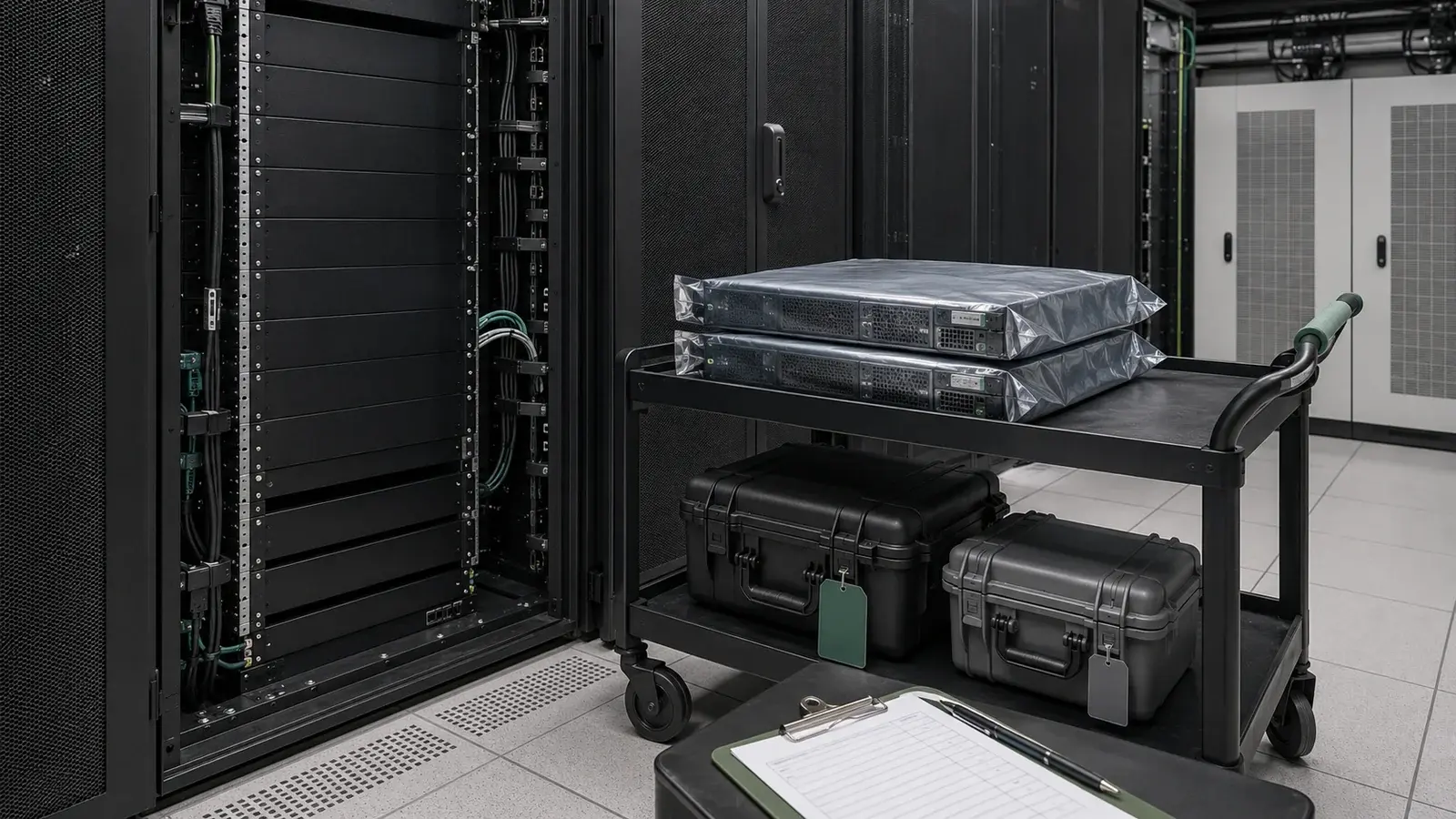
The last server can leave a colocation rack while the customer remains tied to the facility. A circuit may still be billing, a privileged account may still work, one device may have no verified owner, or the carrier may be waiting for a cross-connect release. An empty rack proves removal, not closure.
A useful data center decommissioning checklist must reconcile four scopes: the workload, the physical asset, the supporting service and the obligation that survives until accepted evidence closes it. Planning those relationships before entry or renewal is far cheaper than discovering them after notice has started the clock.
Exit readiness belongs in the entry decision
Entry plans are organized around delivery, installation and go-live. Exit provisions are often left unread because departure feels distant. Yet the original agreement can determine notice, access, removal windows, restoration duties, carrier responsibilities and final reconciliation.
Exit readiness is the ability to identify what must end, who can authorize it, what must physically move and what evidence makes closure defensible.
Planning the exit at entry does not require predicting the future architecture. A minimal register records the governing source, ownership model, notice requirement, dependencies, evidence and unresolved assumptions. Review it at renewal, expansion and migration planning, while unclear terms can still be addressed.
Early exit planning can become speculative bureaucracy if a team writes a runbook for equipment it has not selected. Keep only the obligation register at entry; build the execution plan when scope and timing become real.
Build one authoritative scope across workloads, assets and services
A workload migration and a physical decommission are related projects, not synonyms. Production traffic may have moved while backup jobs, monitoring, scheduled tasks, DNS or management integrations still point to the old environment. A device may be safe to power down yet remain on-site because its ownership or removal authority is unresolved.
Build an authoritative inventory connecting each workload to its owner, hardware identifier, data-bearing status, rack position, attachments, carrier or cross-connect dependency, support contract and intended disposition. Record the source and review date. A procurement spreadsheet is evidence, not automatically the physical truth.
For example, every application may show green while the old rack still contains a console appliance with no known owner or destination. “Remove everything” is then unsafe. Identify the asset, restrict disposition and assign an owner.
Provider-owned racks or PDUs, leased carrier devices and customer equipment may sit together but follow different authorization paths. Label photographs and reconciled identifiers can support the record, subject to facility and security rules; they do not transfer ownership.
Give data-bearing assets a custody decision
Before data-bearing equipment enters a packing case, record its approved disposition, owner, permitted handler, custody transfers, required evidence and the authority approving any sanitization or destruction method.
NIST SP 800-88 Revision 2 defines sanitization in terms of making access to target data infeasible for a given level of effort and frames a program around information sensitivity. It does not support one instruction to wipe, destroy or reuse every device. Technology, policy, duties, device condition and intended disposition can change the answer.
The operational plan coordinates that decision; it does not make it. Security, legal, data-protection, compliance and qualified IT asset disposition (ITAD) professionals set the applicable requirements. Certified destruction, customs and environmental compliance remain specialist domains. The exit owner verifies the approved action and its custody evidence.
Close services and access that can outlive the rack
Physical removal does not terminate a carrier circuit, cross-connect, remote-access entitlement or recurring service. Each needs an owner, action, effective date and acceptance evidence. Revoke access too early and equipment may be stranded; leave it open after handover and exposure remains.
NIST SP 800-53 Revision 5 is a U.S. federal control catalog, not a colocation exit standard. Its separate treatment of accounts, component inventory, media and equipment removal offers a useful decomposition: one “decommissioned” status should not conceal several controls.
Review human and machine credentials, facility access, vendor accounts, out-of-band management, monitoring, DNS, scheduled tasks, carrier services and support portals. Mark each removed, transferred, excepted or outside scope. A circuit cease acknowledgment differs from a cross-connect removal record; closure may need both.
Apply the Exit Readiness Register before notice starts the clock
The Exit Readiness Register is the control surface for the exit. Open it during contracting or renewal, then make it executable when timing is known. Inputs include contracts, policies, current inventories, carrier records, facility procedures, migration plans and logistics requirements.
The exit lead maintains the register; technical and commercial owners accept their rows. Review it at entry, renewal, notice preparation, migration gates and final closure. Closed requires the specified evidence and acceptance owner.
Overall decisions are proceed, partial proceed, hold and close. A blocked safety, ownership, data, access or custody condition holds the affected scope.
The register coordinates work; it does not interpret contracts, determine legal notice, approve a sanitization method, certify destruction, authorize customs movement or establish environmental compliance. Those judgments remain with the appointed specialists.
Run the decommissioning checklist as a closure test
Use this 18-point checklist for each exit scope:
- Record the contract notice requirement, authority, delivery method and acceptance.
- Reconcile the asset inventory to the physical scope.
- Name the owner for every workload in scope.
- Identify every data-bearing asset and its approved disposition path.
- Capture backup or migration confirmation from the accountable owner.
- Obtain application shutdown approval before technical shutdown.
- Review DNS, monitoring and scheduled tasks for old-environment dependencies.
- Submit and track each circuit cease order to acceptance.
- Authorize and evidence each cross-connect removal.
- Revoke facility and work-order access at the correct gate.
- Revoke human, service and management credentials at the correct gate.
- Approve packing method, equipment list and transport authority.
- Record each chain-of-custody transfer.
- Retain secure sanitization evidence where the approved policy requires it.
- Complete the contractual rack or space restoration obligation.
- Capture final photo evidence where facility and security rules permit it.
- Maintain an unresolved asset register with owner, restriction and due date.
- Reconcile final billing, credits, deposits and cease dates with the commercial owner.
Tailor the checklist to the facility, contract, equipment and jurisdiction. Attach evidence or a stable reference to each line, then record complete, blocked, accepted exception or not applicable with an approver. Completion requires evidence for every applicable item and authority, ownership and a resolution date for every exception.
A cleared rack can still fail the closure gate
Consider a fictional customer that has migrated its workloads and booked a controlled pickup. Its initial assumption is that the rack and service can close that day. Evidence includes shutdown approvals, a mostly reconciled asset list, an accepted circuit cease order and an approved removal window.
Three dependencies remain: one storage appliance does not match the inventory; access expires before the ITAD carrier's revised arrival; and nobody owns cross-connect removal evidence. Workloads are elsewhere, but ownership, custody and commercial closure remain open.
The exit lead chooses partial proceed. Matched equipment leaves under the approved packing list and custody record. The unidentified appliance remains powered down and access-restricted until its owner and disposition are resolved. Named access receives a defined extension; network and commercial owners take the cross-connect acceptance and final bill check.
This example is illustrative only. Selective release preserves progress without turning an unresolved asset into an unauthorized removal or declaring the exit closed.
A decision-ready output contains the exit plan, decommissioning dependency register and evidence checklist. It reconciles notice, migration approval, asset disposition, custody, access and credential revocation, circuit and cross-connect closure, restoration, exceptions and billing, with an acceptance owner and date.
That package preserves management options: renegotiate access, resequence removal, retain a service, appoint a specialist, restrict one asset or hold final closure without stopping safe work.
The rack is finished when it is empty. The exit is finished when the organization can show that every applicable workload, asset, service, access right, obligation and exception reached an authorized end state.
If your organization is negotiating, renewing or leaving a colocation arrangement in Azerbaijan, I can develop an exit-readiness plan and evidence register that exposes technical dependencies before notice or removal begins. Where local execution evidence is the gap, I can also provide controlled on-site verification and deinstallation oversight against the approved plan.