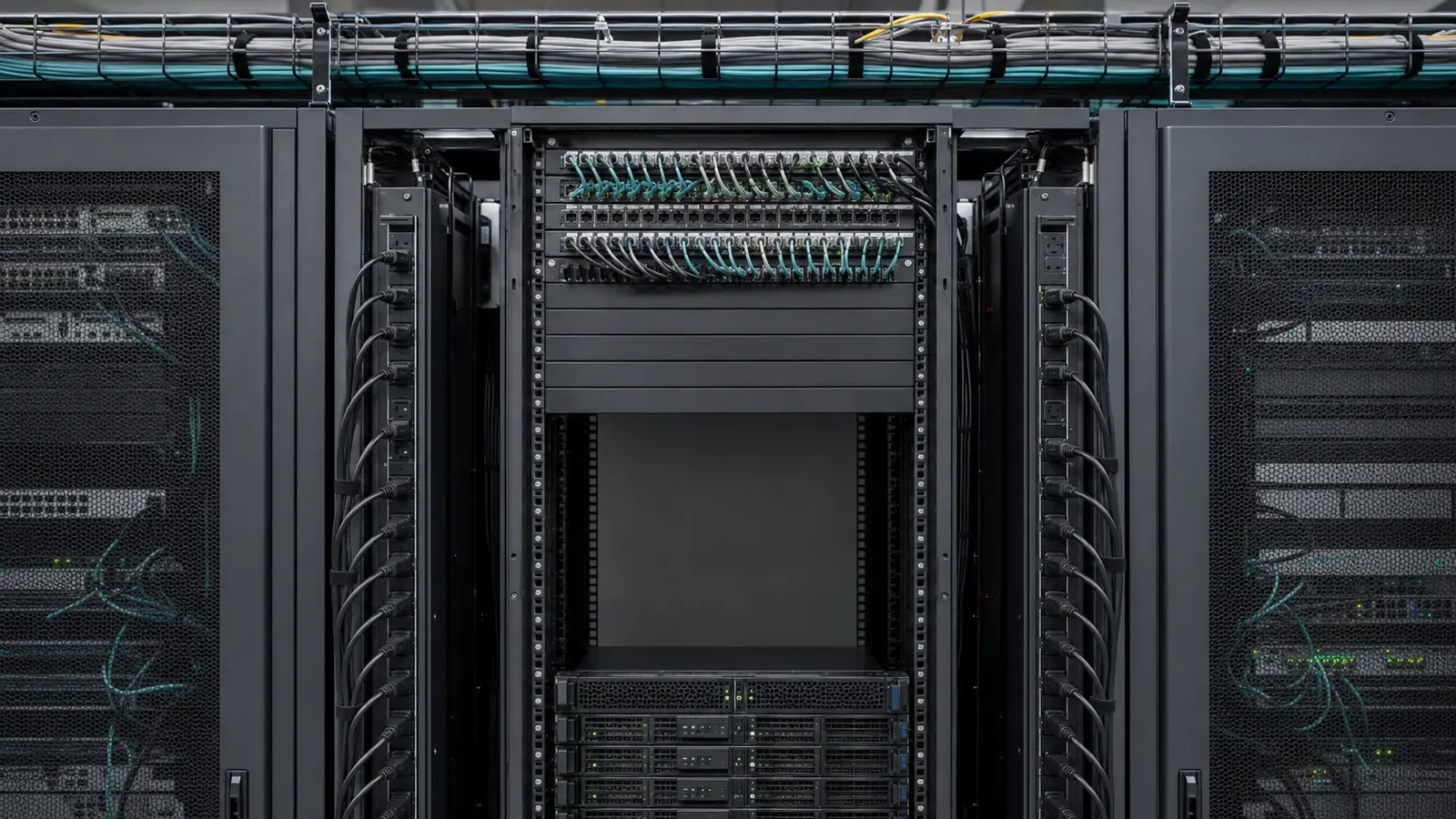
An expansion request can fail in a rack with twenty unused units. The physical space exists, but the remaining power is not available at the required density, the correct ports are already committed, or a cross-connect cannot be delivered before the deployment date. Nothing in the empty rack reveals those constraints.
Data center capacity planning should therefore answer a time-bound operating question: Can this specific deployment be installed, supported and recovered at the required location and date without violating an agreed constraint? Rack count is one input. Available capacity is the intersection of every resource and approval needed to say yes.
Rack count describes space, not deployability
Rack units are visible and easy to total, which makes them attractive in planning meetings. They do not show whether the rack can accept the equipment's weight or depth, whether power can be delivered on the required paths, whether the cooling arrangement supports the expected load, or whether network and power ports remain available in the right place.
The same problem appears at room level. A provider may accurately report spare floor space or an unallocated power figure. The customer's next wave may still be blocked by its particular density, circuit, cross-connect, support or timing requirements. The provider statement is not wrong; it answers a broader question than the deployment decision.
Capacity is not the largest number on a facility report. It is the set of resources that can converge for an approved workload by the date they are required.
This does not make dashboards or data center infrastructure management (DCIM) tools unimportant. They can provide strong evidence of current allocation and utilization. Their output becomes decision-ready only after it is mapped to the planned equipment, location, operating envelope, resilience assumptions and delivery schedule.
Four capacity states prevent one number from doing four jobs
The Capacity Envelope distinguishes four states that are often collapsed into “available”:
- Theoretical capacity is a design or nameplate limit under stated assumptions. It establishes an outer boundary, not an entitlement or deployment commitment.
- Allocatable capacity is the portion that the provider or internal authority can reserve for the customer without breaching existing commitments or the agreed redundancy policy.
- Deployable capacity is allocatable capacity that can be made usable at the required rack and date, with physical fit, power, cooling, ports, cross-connects, access, procurement and approvals ready.
- Recoverable capacity is the portion that can continue or be restored under the agreed maintenance and failure conditions, including the required spare, support and replacement path.
These are advisory distinctions, not claims of universal industry terminology. Their purpose is to expose what evidence a decision needs. A design document may support theoretical capacity; an executed reservation may support allocatable capacity; current installation and order evidence support deployability; and tested recovery arrangements support recoverability.
The distinction also prevents false subtraction. Taking current load from a headline maximum may produce a mathematically correct remainder that cannot be used in the proposed location. Constraints are coupled and time-dependent, so the practical ceiling is the first resource that fails the deployment's conditions.
Find the first constraint across the whole envelope
Capacity management is already broader than space. ISO/IEC TS 22237-7 includes capacity planning within data center operational processes, while Schneider Electric describes capacity management as balancing supply and demand across resources including power, cooling, space and network connectivity. A customer-side review extends that evidence to the deployment and its required date.
Assess thirteen dimensions:
- Physical space: usable rack units or floor position at the required location.
- Structural and equipment constraints: rack depth, weight, rails, airflow direction and service clearance.
- Power allocation: the amount contractually or internally reserved.
- Actual power delivery: the usable paths, receptacles and local distribution available for the equipment.
- Cooling and environmental capability: whether the intended placement can stay within the applicable equipment and facility envelope.
- Network and power ports: the correct port types and positions, not a campus-wide total.
- Cross-connect availability: pathway, panel and service readiness.
- Carrier lead time: order, delivery and acceptance timing for the required service.
- Spare and replacement capacity: parts and substitute capacity needed to maintain the recovery model.
- Operational support capacity: people, access windows, change throughput and response arrangements.
- Procurement lead time: equipment, optics, racks, PDUs or other customer dependencies.
- Expansion approval: provider, change, budget, security and specialist approvals.
- Customer growth timing: the sequence and latest acceptable date for each wave.
Power density illustrates why these dimensions interact. Uptime Institute calls kilowatts per cabinet a critical input to power and cooling provisioning. That does not authorize a buyer to calculate a facility's safe limit from a generic rule.
Equipment class, airflow and environmental conditions matter; ASHRAE's data center resources exist precisely because thermal assessment is specialized. Detailed electrical or mechanical validation remains with the provider and the client's qualified engineers.
Forecast demand in waves, not annual totals
A yearly statement such as “we need two more racks” conceals sequence. One early appliance may need a carrier service with a long lead time; a later compute wave may create the density constraint; a spare requirement may consume the last compatible position before either arrives.
Use one worksheet row per deployment wave at 6, 12 and 24 months. Review it with the service owner, infrastructure engineering, network, facility/provider contact, procurement and the person authorized to release the wave.
Full worksheet schema
- Planned deployment
- Rack units
- Expected power
- Maximum power scenario
- Cooling or density consideration
- Network ports
- Cross-connects
- Carrier lead time
- Spare requirement
- Approval lead time
- Limiting constraint
- Action date
For each technical field, record the evidence status as verified, reserved, ordered, estimated, unknown or blocked. “Available” should not be accepted without a source, date, scope and owner.
Publication view of the 6-, 12- and 24-month worksheet
Apply the worksheet from right to left. Start with the required deployment date, subtract verified external and approval lead times, and identify the latest action date. Then test whether every demand field has adequate evidence.
The wave decision is release, conditional release, hold, or redesign. Any unknown that can invalidate physical fit, safety, connectivity or the recovery design is a hold condition, not a note for later.
A worked hypothetical expansion exposes the real ceiling
Consider a fictional customer planning a backup appliance pair in the six-month horizon. The team begins from an assumption: the wave is low risk because the destination rack has space and the provider has confirmed that the customer's contracted power allocation is not exhausted.
The evidence supports the rack position, rails and ordinary operating estimate. Network ports have been reserved, and a compatible spare appliance is held off-site. Two gaps remain: the maximum power scenario has not been supplied to the provider for placement review, and the second carrier service is ordered but has no accepted delivery date.
The worksheet records the circuit as the immediate limiting constraint and the unreviewed maximum load as a second hold condition. The decision is hold, not because the facility lacks capacity, but because deployable capacity for this wave has not been established by the required date. The action owners are different: the network lead closes carrier acceptance; the equipment owner supplies the maximum-load evidence; the provider or appointed engineer confirms placement within the applicable envelope.
Once both conditions are verified, the same rack may move from theoretical and allocatable capacity to deployable capacity. Recoverable capacity remains a separate decision until the spare location, access route and replacement responsibility meet the customer's recovery requirement.
The example is illustrative only and contains no real site figures. Its purpose is to show how the first constraint, rather than the most visible resource, controls the wave.
Translate the constraint into a management action
A decision-ready capacity review should produce a time-phased demand forecast, evidence-backed Capacity Envelope, constraint register and action calendar. Each constraint needs an owner, latest safe action date, consequence if missed, evidence required for closure and escalation authority.
This changes management choices. Leadership may reserve power earlier, order connectivity before hardware, split a wave, choose a different rack position, retain temporary capacity elsewhere, amend a renewal requirement or ask qualified engineers to validate a density change. The review does not decide which trade is commercially best; it shows which options remain physically and operationally credible.
An empty rack can be useful evidence of space. It cannot prove power, cooling, connectivity, support or recoverability, and a customer-side worksheet cannot certify facility engineering. Capacity is available only for a defined deployment, operating condition and date; every unverified specialist assumption must remain visible beside that claim.
Relevant infrastructure publications can help sharpen review questions, but they are not evidence for a specific rack, facility, or capacity commitment.
If your team is planning expansion or renewal in Azerbaijan, I can provide an independent capacity and expansion-readiness review that identifies limiting constraints, evidence gaps and latest action dates. The output is a phased recommendation your engineering, procurement and appointed facility specialists can use to release, hold or redesign each deployment wave.