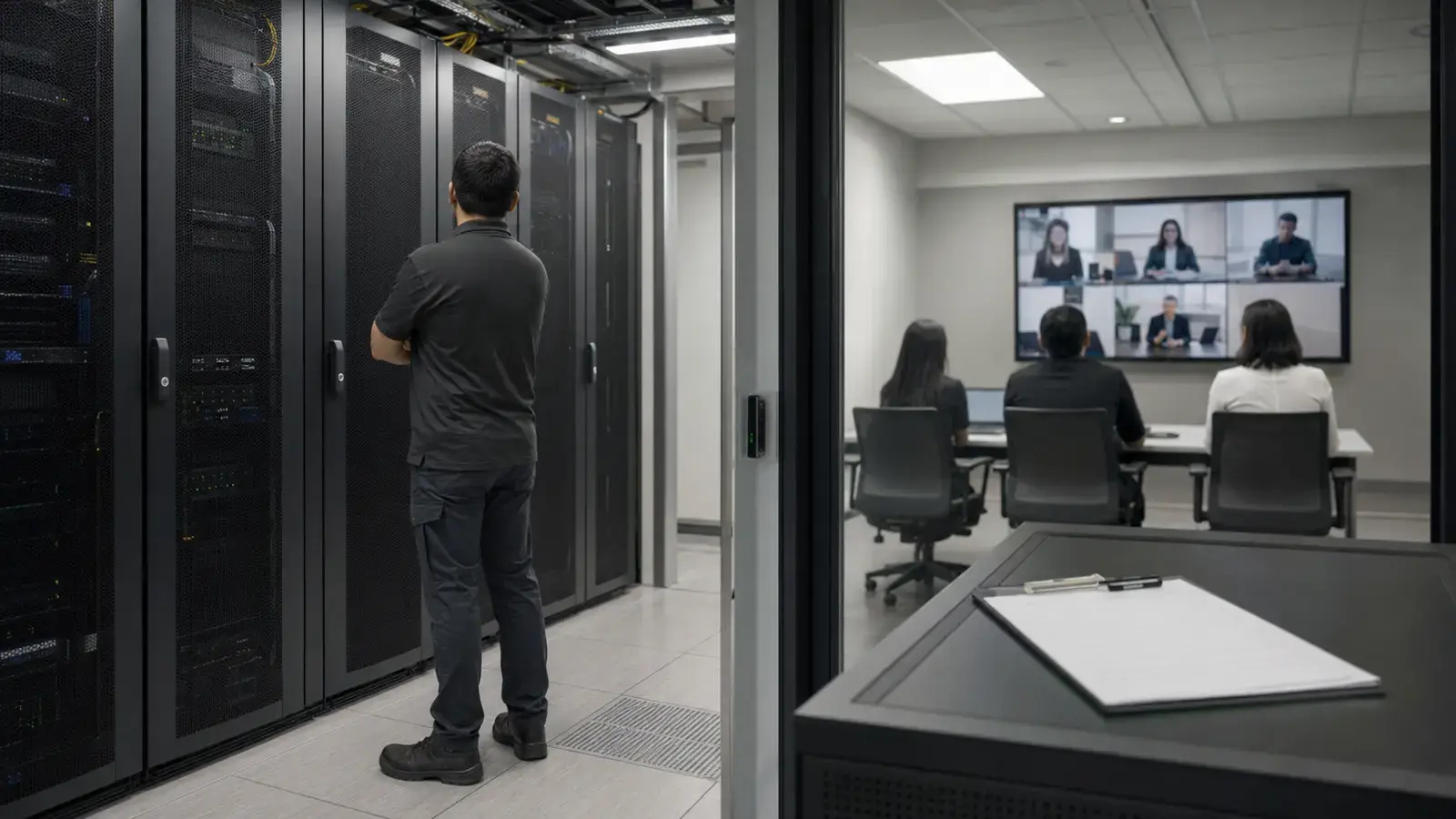
A team can own every server remotely and still be unable to replace one failed component. The engineer with system authority is in another country. The approved visitor is no longer on the access list. The correct spare is in Baku, but nobody on the incident call can release it. Each dependency existed before the failure; the failure merely connected them.
Infrastructure managed from abroad therefore needs more than monitoring and a list of local contacts. It needs a local operating model: an agreed system of responsibility, authority, access, evidence and escalation that remains usable under maintenance and incident conditions.
Remote ownership does not remove local dependencies
Remote management centralizes expertise. It does not virtualize the rack, security desk, spare cabinet, carrier demarcation or facility procedure. Physical action still crosses customer, facility, carrier, vendor and local-executor boundaries.
This boundary is where simple tasks acquire delay. A network card may be on site but not releasable. A carrier engineer may be ready while no customer contact can authorize access. Requested photographs may require prior permission. Equinix’s public documentation, for example, separates work-visit access, permissions, scope and recording approval. Processes vary; access remains a workflow, not a location.
Design the model from the outcomes the business must protect. If recovery assumes an after-hours component change, access, spare release, authority and validation must support it. A Remote Hands service covers only part of the chain.
Useful distinction: a contact list tells people whom they might call. An operating model defines who owns the outcome, what each party may do and how the work reaches verified closure.
Define one accountable responsibility model
Start with scenarios, not job titles. Installation, carrier maintenance, component failure, loss of remote management and urgent inspection each need a named outcome owner. That owner may delegate tasks but remains responsible across boundaries.
[TABLE]
Record primary and alternate contacts, time zones, channels and authority limits. “Infrastructure team” is not an accountable role. Neither is an unmonitored group mailbox.
This principle is consistent with NIST SP 800-61 Rev. 3, which embeds incident response in defined roles, responsibilities and authorities. The publication addresses cybersecurity, but the governance point transfers cleanly to physical response: responsibility without authority creates an escalation queue, not ownership.
Control access, authorization and stop conditions
Access has at least four states: eligibility, approval, scheduling and successful entry. “John has access” is insufficient if he still needs a work ticket, lacks cabinet permission or cannot attend. Record who submits and approves requests, required documents, contracted lead time and the alternate visitor path.
Authorization should be equally specific. A local executor may be permitted to read labels, connect a console and replace a customer-designated component, but prohibited from moving adjacent cables, selecting a substitute part or power-cycling another device. A stop condition converts ambiguity into a controlled pause: asset label mismatch, undocumented cabling, damaged packaging, unexpected LEDs, missing grounding provision, or any observed state inconsistent with the approved plan.
Hypothetical example: the request says to replace NIC serial X in server R12-U18. On site, the server label matches but the installed card is in a different slot from the diagram. A weak model rewards continuation because the maintenance window is short. A controlled model requires the executor to stop, provide specified evidence and escalate to the remote technical owner. The delay is visible and bounded; an unauthorized change is avoided.
A scenario-based data center RFP can test whether a provider supports the required task envelope. The local operating model defines who creates, authorizes and owns that envelope across repeated work.
Prepare spares, maintenance and vendor coordination
A spare is useful only if it is compatible, identifiable, accessible and ready. Record custodian, location, release authority, inventory ID, compatibility basis, handling and replenishment. State whether firmware, licenses or configuration artifacts require preparation.
Maintenance introduces a different coordination chain. The facility may announce building work; a carrier may schedule a network change; the customer must decide whether to freeze its own changes, increase monitoring or arrange local attendance. The local model maps who receives each notice, who assesses customer impact, who acknowledges the vendor, and who verifies normal service afterward.
Hypothetical example: a carrier maintenance notice reaches procurement, while the network team abroad never sees it. The alternate circuit exists, but its physical route relationship is only partially verified. A functioning model routes the notice to an accountable network owner, exposes the unresolved shared dependency and assigns pre- and post-maintenance checks. The value comes from the connected process, not from another email distribution list.
Uptime Institute’s public Management and Operations Guideline treats staffing, maintenance, training, planning and operating conditions as distinct but connected behaviors. That facility-level guidance does not prescribe a customer’s remote operating model, but it reinforces why vendor support, documented roles and scripted procedures must be designed together.
Specify evidence and closure requirements
“Completed” often means different things to different parties. Installation may be finished while the asset record is stale, the device unreachable or the evidence inadequate for restoration.
Define closure before dispatch. Required evidence may include pre-action and post-action photographs where facility policy permits, asset and component identifiers, cable-end confirmation, console output supplied through an approved channel, timestamps, observed anomalies, and an explicit statement of steps not completed. Evidence should be sufficient for the remote owner to validate the expected state without encouraging collection of unnecessary sensitive data.
The final status should be one of a small controlled set: completed and validated; physical action completed, remote validation pending; stopped and escalated; access blocked; or scope not executable. This prevents a ticket from closing merely because the local person left the site.
Name an evidence custodian. Decide where records live, who can access them, how they link to the change and how corrections work. A private-chat photo is not a durable record.
Build and test the Local Operating Model Canvas
Complete the canvas for each site and material scenario:
- Responsibility: one accountable owner and alternates.
- Access: eligibility, approval, time-window and cabinet process.
- Authorized actions: explicit permissions by task class.
- Stop conditions: observations that prohibit continuation.
- Facility contacts: operations, security and service desk paths.
- Carrier contacts: service IDs, support path and escalation owner.
- Remote Hands: scope, ordering permissions and service limitations.
- Spares: custody, identity, readiness, release and replenishment.
- Evidence: required artifacts, approved channels and retention owner.
- Escalation: thresholds, decision rights and communication path.
- Incident dispatch: who decides to send someone, under what criteria.
- Review cadence: owner, date and change-triggered reassessment.
Do not validate the canvas only by reading it. Run a tabletop scenario, then a controlled practical test where appropriate: submit a non-urgent access request, locate a named spare without opening it, confirm that alternates answer, and exercise evidence transfer. CISA’s tabletop exercise resources are designed to expose role and responsibility gaps; the same exercise logic can be adapted to a customer’s local physical dependencies.
Review after provider, staff, circuit, rack or authorization changes and after every real activation. The decision-ready output is a local operating model, escalation matrix and prioritized readiness action plan with owners and deadlines. It should show not only the intended workflow, but the unproven assumptions that could still interrupt it.
A remote team does not need to recreate itself in every country. It does need a locally executable extension of its authority, evidence and recovery process.
Managing infrastructure in Azerbaijan without a permanent local engineering team? I design and validate local operating models, escalation matrices and readiness plans for international teams.
Where an incident already requires physical escalation, controlled on-site support in Azerbaijan can be scoped separately around the approved task and access conditions.