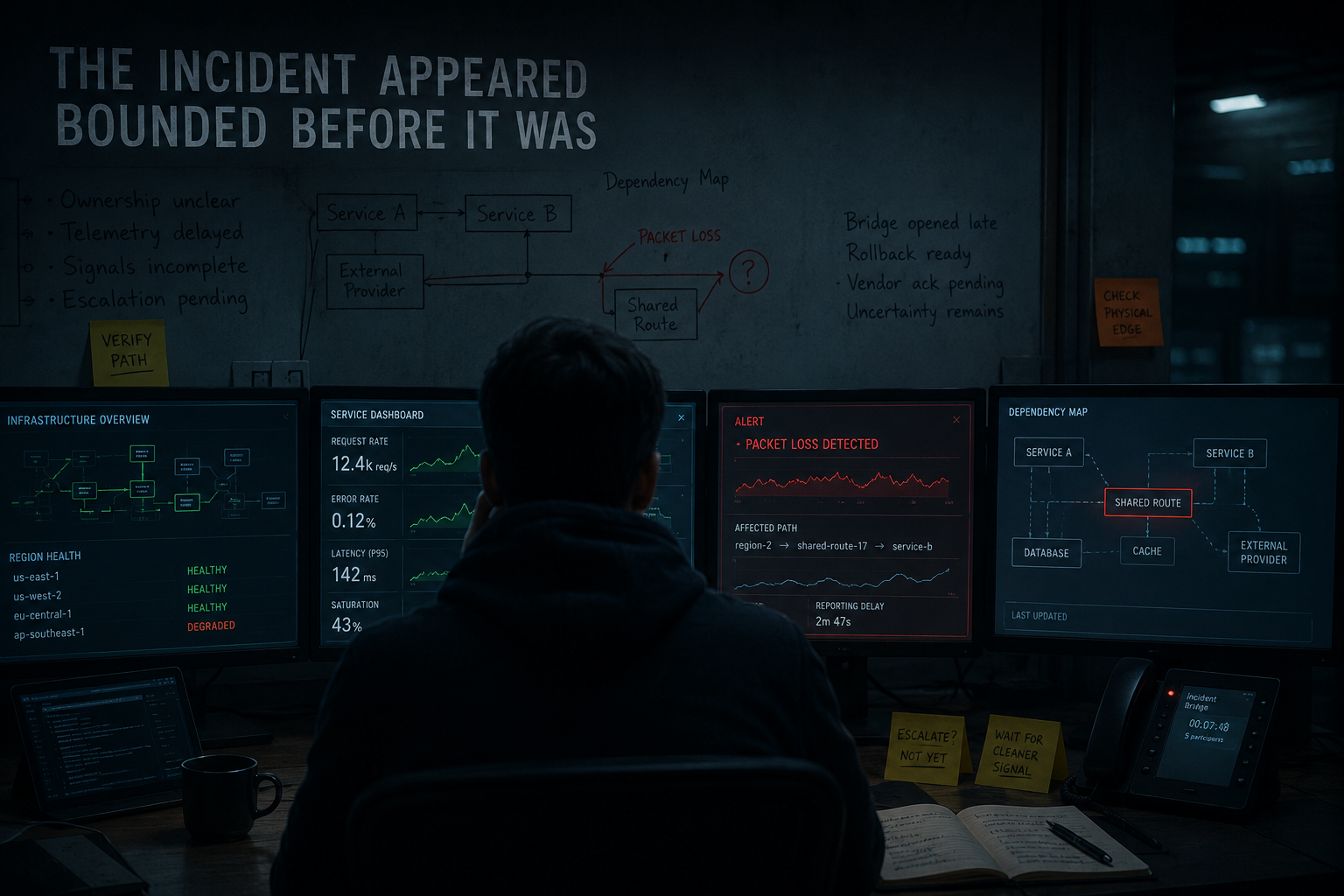
The alert was visible before the condition was understood.
Telemetry reduces uncertainty.
Until it starts preserving the wrong certainty.
A dashboard can show capacity while redundancy is already thinning behind it. A trace can end cleanly because the failing dependency sits outside the traced path. A region can report normal latency while another team sees packet loss through a shared route no one modeled as operationally critical.
Monitoring is not operational certainty.
It is a reporting layer with its own visibility scope.
When the reporting layer is delayed, recovery starts late. When it is incomplete, ownership narrows too early. When it is asymmetric, one team closes the incident while another keeps reopening the dependency map.
The event timing gets checked again.
The numbers still look acceptable.
So escalation waits longer than intended.
That delay matters. Escalation uncertainty behaves like infrastructure latency because delayed ownership delays recovery convergence. The system keeps degrading while the organization waits for a cleaner interpretation of the same condition.
Green dashboards can coexist with silent degradation.
A redundant path may still exist in the diagram, but if it shares the same maintenance window, routing assumption, shared timing dependency, or operational edge, the redundancy has already started collapsing before the topology reflects it.
The dashboard still renders normally.
A bridge opens late because the first explanation sounded sufficient. A rollback plan gets opened and minimized again. Someone types the escalation message, rereads the vendor acknowledgment thread, then waits before sending it.
Not because the signal is absent.
Because the signal is partial.
Distributed systems do not fail uniformly. Some failure domains become noisy immediately. Others degrade quietly behind cached health checks, delayed telemetry ingestion, or dependency paths outside the monitored scope.
One team sees saturation.
Another sees healthy failover.
A third sees normal replication lag.
The observability path depended on the same thing that was already weak.
That dependency matters because observability stacks inherit infrastructure assumptions from the environments they monitor. Ingestion paths, agents, storage layers, permissions, and synchronization paths can all degrade unevenly during the same event they are supposed to clarify.
So telemetry preserves confidence longer than the infrastructure preserves margin.
The incident appears understandable before it is actually bounded.
That is usually where recovery slows down.
Not during the first alert.
During the period where operators still believe the failure surface is smaller than it really is.
Someone reopens the maintenance notes.
A service is still reporting healthy because it cannot see the operational edge that already failed.
Telemetry reduces uncertainty.
Until it starts preserving the wrong certainty.
A dashboard can show capacity while redundancy is already thinning behind it. A trace can end cleanly because the failing dependency sits outside the traced path. A region can report normal latency while another team sees packet loss through a shared route no one modeled as operationally critical.
Monitoring is not operational certainty.
It is a reporting layer with its own visibility scope.
When the reporting layer is delayed, recovery starts late. When it is incomplete, ownership narrows too early. When it is asymmetric, one team closes the incident while another keeps reopening the dependency map.
The event timing gets checked again.
The numbers still look acceptable.
So escalation waits longer than intended.
That delay matters. Escalation uncertainty behaves like infrastructure latency because delayed ownership delays recovery convergence. The system keeps degrading while the organization waits for a cleaner interpretation of the same condition.
Green dashboards can coexist with silent degradation.
A redundant path may still exist in the diagram, but if it shares the same maintenance window, routing assumption, shared timing dependency, or operational edge, the redundancy has already started collapsing before the topology reflects it.
The dashboard still renders normally.
A bridge opens late because the first explanation sounded sufficient. A rollback plan gets opened and minimized again. Someone types the escalation message, rereads the vendor acknowledgment thread, then waits before sending it.
Not because the signal is absent.
Because the signal is partial.
Distributed systems do not fail uniformly. Some failure domains become noisy immediately. Others degrade quietly behind cached health checks, delayed telemetry ingestion, or dependency paths outside the monitored scope.
One team sees saturation.
Another sees healthy failover.
A third sees normal replication lag.
The observability path depended on the same thing that was already weak.
That dependency matters because observability stacks inherit infrastructure assumptions from the environments they monitor. Ingestion paths, agents, storage layers, permissions, and synchronization paths can all degrade unevenly during the same event they are supposed to clarify.
So telemetry preserves confidence longer than the infrastructure preserves margin.
The incident appears understandable before it is actually bounded.
That is usually where recovery slows down.
Not during the first alert.
During the period where operators still believe the failure surface is smaller than it really is.
Someone reopens the maintenance notes.
A service is still reporting healthy because it cannot see the operational edge that already failed.